New Customer Acquisition: Enterprise Strategies for Sales Success
Turning a prospect into a paying customer never happens in one step. It’s a structured sequence: identification, qualification, engagement, and deal execution, all building toward a signed agreement.
In enterprise B2B sales, new customer acquisition is the most resource-intensive revenue motion a sales team undertakes. Enterprise deals require months of relationship development, multi-stakeholder engagement, competitive positioning, and qualification discipline before a purchasing decision is reached.
The organizations that acquire new customers most consistently do not simply work harder than their competitors. They work with greater precision: targeting the right accounts, engaging the right people, and executing the right process at each stage of the buying journey.
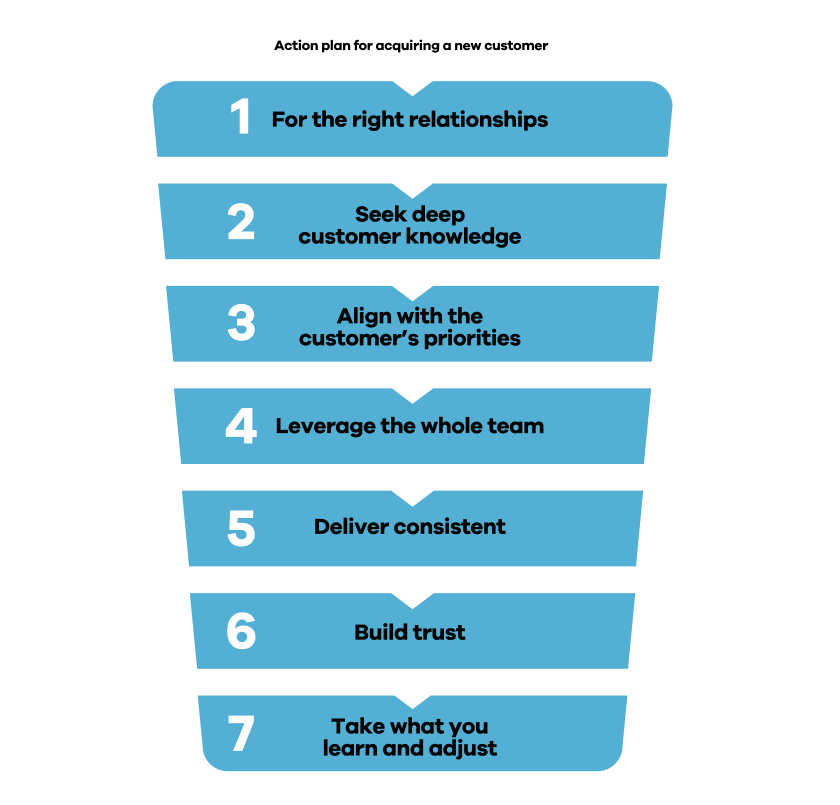
What Defines a New Customer?
There’s no single industry-wide answer to this. What counts as “new” varies by business model, brand structure, and fiscal year conventions.
The definition of “new customer” matters for acquisition metrics, marketing investment decisions, and revenue attribution. Common definitional approaches in enterprise B2B organizations include:
- First purchase date: The most straightforward definition tracks the date of an account’s initial contract. This method allows tracking of customer progression from the first purchase through subsequent expansion.
- Brand or product line: Organizations with multiple product lines or brands may define new customers at the brand or product level, recognizing that a customer new to one product may be an existing customer at the organizational level.
- Fiscal year: Some organizations define new customers within a fiscal year context, categorizing accounts as new or returning based on whether they purchased in the prior period. This approach is particularly useful for assessing the health of the acquisition pipeline relative to revenue composition goals.
Regardless of the definition used, the key operational question is consistent: what is the customer acquisition cost, and what is the expected lifetime value of the account being pursued?
That cost-versus-value question only matters, though, if acquisition itself is worth the investment in the first place.
Unleash the Power of Altify Insights
Altify Insights, our new solution elevates team collaboration, builds customer intimacy, and drives revenue by enabling you to understand WHO the key buyer decision makers are, and HOW you solve their challenges natively in Salesforce.

Why New Customer Acquisition Matters in Enterprise B2B
A revenue base built entirely on existing accounts is a fragile one. New customers expand it, reduce concentration risk, and build the pipeline of future key accounts that enterprise revenue teams depend on.
Existing customers are the most efficient source of revenue. Research from Bain and Company confirms that acquiring a new customer costs 5 to 25 times more than retaining an existing one. The mathematics of enterprise revenue strongly favor customer retention and expansion over aggressive new logo pursuit.
Yet new customer acquisition is not optional for enterprise revenue teams with growth mandates. Revenue retention without new customer acquisition produces flat or declining growth as accounts churn, contract, or consolidate.
The disciplined enterprise revenue strategy invests in both motions simultaneously by maximizing expansion in existing accounts while building a systematic pipeline of new customers that meet the ideal customer profile:
- Revenue diversification: New customers reduce dependence on any single account or account cohort. Organizations with concentrated revenue streams face disproportionate risk when key accounts are disrupted by leadership change, acquisition, or competitive displacement.
- Market intelligence: New customers introduce the revenue team to new industry segments, use cases, and deployment patterns that inform product development and competitive positioning.
- Reference network expansion: New customers in high-profile accounts become the social proof that accelerates subsequent acquisition in similar organizations. Enterprise buyers trust peers in comparable organizations more than they trust seller-produced marketing materials.
Knowing why acquisition matters doesn’t make it happen. That takes a process, and it starts long before a prospect ever talks to a seller.
The Enterprise Customer Acquisition Funnel
Four stages carry a prospect from first contact to signed agreement: awareness, qualification, engagement, and deal execution, each demanding a different kind of seller effort.
Awareness and Market Presence
Prospective customers cannot evaluate a solution they have never encountered. Enterprise organizations build market presence through content authority, executive visibility, analyst relationships, peer community participation, and targeted account-based marketing. The goal at this stage is not conversion. It is the establishment of enough market presence that when a target account enters the market to evaluate solutions, the seller is already known.
Qualification and ICP Targeting
Not every prospect that becomes aware of a solution represents a genuine acquisition opportunity. ICP targeting applies the ideal customer profile criteria (firmographic fit, technology environment, buying process maturity, and strategic priority alignment) to identify the prospects most likely to convert at a sustainable acquisition cost.
The BANT framework provides the deal-level qualification structure that complements ICP targeting. ICP identifies which accounts are worth pursuing. BANT assesses whether the specific opportunity within that account has the budget, authority, need, and timeline required to close.
Active Engagement and Stakeholder Development
Once a qualified prospect is identified, the acquisition process requires systematic stakeholder development. Enterprise purchase decisions involve multiple buyers with different evaluation criteria. A seller who builds a strong relationship with a single champion but fails to establish executive access, technical credibility, and operational alignment is structurally exposed at the decision stage.
Relationship mapping at the acquisition stage documents the full buying group, identifies the engagement gaps, and guides the account team’s outreach investment toward the contacts whose alignment is most critical to the purchase decision.
Deal Execution and Close
Deal execution in enterprise acquisition requires the same disciplined process as deal management in existing accounts: verified qualification, complete stakeholder coverage, clear understanding of decision criteria, and a documented mutual close plan. Deals that enter the execution phase without these foundations are more likely to stall, lose to a competitor, or produce a no-decision outcome.
Guided deal execution gives enterprise sales teams the coaching, qualification prompts, and stakeholder management support needed to execute consistently at this stage. Executing well at each stage is one thing. Building a repeatable strategy that gets prospects to that stage in the first place is the harder problem.
Strategies for Acquiring New Enterprise Customers
The most effective new customer acquisition strategies in enterprise B2B combine ICP-driven targeting with multi-channel engagement, structured qualification, and disciplined deal execution rather than relying on volume-based outreach or reactive inbound pursuit.
ICP-Driven Prospecting
Begin with a well-defined ideal customer profile and apply it to the prospecting process. Target accounts that match the firmographic, technographic, and strategic characteristics of your highest-value existing customers. ICP-driven prospecting produces smaller prospect lists with significantly higher win rates than broad outreach campaigns.
Analyze your existing accounts to identify the patterns that predict success. Which industries, company sizes, technology environments, and strategic priorities have produced your most profitable, fastest-closing, and longest-retained customers? Build the acquisition target list from those patterns.
Executive Relationship Development
Enterprise purchase decisions are ultimately made by senior executives with authority over budget allocation and strategic direction. Acquisition strategies that rely entirely on mid-level champion development without establishing executive alignment are structurally fragile.
Develop a deliberate executive engagement strategy: executive briefings, peer network introductions, thought leadership engagement, and direct outreach to senior decision-makers at target accounts. The relationship built at the executive level before a formal evaluation begins often determines the outcome of the competitive process that follows.
By the time an RFP lands, the executive relationships that will decide it are usually already in place. The formal process just confirms what was already true.
Multi-Channel Presence
Enterprise buyers conduct research across multiple channels before initiating vendor contact. Content authority (industry-specific perspectives on challenges the buyer is actively managing), peer community visibility, and analyst coverage influence vendor shortlisting before a prospect engages with the seller directly.
Marketing and sales alignment on target account engagement ensures that brand presence, content, and outreach are coordinated toward the same high-priority acquisition targets rather than pursuing disconnected parallel motions.
Structured Qualification and Pipeline Discipline
Discipline at the qualification stage prevents the acquisition pipeline from becoming congested with low-probability opportunities that consume seller time without producing revenue.
Apply ICP criteria at the account selection stage and BANT criteria at the deal qualification stage. Opportunities that do not meet qualification thresholds should be deprioritized or placed in long-cycle nurture programs rather than treated as an active pipeline.
All of this effort raises an obvious question: given how much acquisition costs, is it even worth prioritizing over retention?
New Customer Acquisition vs. Customer Retention
| Dimension | Acquiring a New Customer | Retaining an Existing Customer |
|---|---|---|
| Acquisition cost | 5 to 25 times higher than retention. (Bain and Company) | Significantly lower: relationship and product knowledge are already established. |
| Relationship foundation | Must be built from the first conversation. | Already exists; depth determines retention risk. |
| Qualification requirement | Full ICP and BANT qualification required. | Expansion qualification within a known account context. |
| Competitive risk | Open competition: no incumbent advantage. | Incumbent advantage, but vulnerable if value is not continuously demonstrated. |
| Sales cycle length | Typically longer due to relationship development requirements. | Typically shorter for expansions due to established trust and procurement history. |
| Win rate | Generally lower than expansion within existing accounts. | Generally higher: existing buyers have already validated the seller’s value. |
The acquisition cost differential reinforces why enterprise revenue strategy must balance new customer acquisition with disciplined account planning and expansion in existing accounts. Balancing the two is a strategic question. Executing an acquisition well once you’ve committed to it is an operational challenge.
How Deal Management Accelerates New Customer Acquisition
Best performers don’t just have better instincts. They execute a more disciplined process, and structured deal management is what makes that process repeatable across the rest of the team.
Without a consistent deal management process, acquisition outcomes vary significantly based on individual seller experience and judgment. Best performers win deals that average performers lose, not because they have better relationships in the abstract, but because they execute a more disciplined process: they qualify more rigorously, engage more stakeholders at the right level, and manage the competitive dynamics more effectively.
Deal management platforms that embed methodology inside Salesforce give every seller access to the same qualification prompts, stakeholder mapping support, and coaching guidance that best performers apply instinctively. This consistency produces more predictable acquisition outcomes across the full revenue team.
That consistency doesn’t happen by accident. It requires the right infrastructure built into the seller’s actual workflow.
How Altify Supports New Customer Acquisition
Our Opportunity Map and MaxAI platform give enterprise revenue teams the account intelligence, qualification guidance, and deal coaching needed to compete effectively for new customers. Relationship Maps document the full buying group at target accounts and identify the engagement gaps that most directly threaten acquisition outcomes.
MaxAI automates external account research, surfacing the strategic priorities and organizational context that enable sellers to enter acquisition conversations at the level of business relevance executive buyers require.
Every acquisition pursuit benefits from the same structured execution: complete stakeholder coverage, verified qualification, and real-time deal coaching inside the Salesforce opportunity record.
Frequently Asked Questions
What does acquiring a new customer mean?
Acquiring a new customer means converting a prospect who has not previously purchased from the business into a paying customer through a structured sales process that ends in a signed agreement. In enterprise B2B sales, this process involves ICP targeting, multi-stakeholder engagement, qualification, competitive positioning, and disciplined deal execution.
Why is acquiring a new customer more expensive than retaining an existing one?
Acquiring a new customer is more expensive because it requires building the relationship, organizational trust, and product knowledge from scratch, without the established credibility and procurement history that make renewal and expansion conversations more efficient. Research from Bain and Company estimates that new customer acquisition costs 5 to 25 times more than retention, depending on industry and deal complexity.
What is the customer acquisition cost?
Customer acquisition cost (CAC) is the total sales and marketing investment required to convert a prospect into a paying customer, expressed as a cost per new customer acquired. It includes seller time, marketing spend, technical resource involvement, and the overhead of the sales infrastructure required to support the acquisition motion. Sustainable enterprise acquisition requires that customer lifetime value significantly exceeds customer acquisition cost.
How does the ideal customer profile affect new customer acquisition?
The ideal customer profile determines which prospects are worth acquiring in the first place. Organizations that pursue new customers without an ICP-based targeting filter acquire accounts at a higher cost, with lower retention rates, and with less expansion potential than those that invest in ICP-driven prospecting.
The ICP ensures that acquisition resources are directed toward prospects with the organizational characteristics that predict strong win rates, fast deal velocity, and long customer lifetime value.
How does the BANT qualification apply to new customer acquisition?
BANT qualification applies to new customer acquisition by ensuring that deals meet the threshold for Budget, Authority, Need, and Timeline before significant seller resources are invested in the pursuit.
The qualification discipline prevents pipeline contamination from prospects who are interested but not yet ready to buy, protecting seller time for the highest-probability opportunities.
What is the relationship between new customer acquisition and account planning?
New customer acquisition is the process of winning a prospect’s first purchase. Account planning begins immediately after the first sale to build the relationship infrastructure that converts a new customer into a retained and growing account. Organizations that treat acquisition and account planning as separate motions lose the continuity of relationship knowledge that makes the transition from new customer to trusted partner efficient.
How does deal management affect new customer acquisition outcomes?
Structured deal management improves new customer acquisition outcomes by giving every seller a consistent process for qualification, stakeholder engagement, competitive positioning, and close planning.
Without a common deal management framework, acquisition results vary significantly by individual seller. Deal management platforms that embed methodology inside Salesforce make that consistency scalable across the full revenue team.
What are the most common reasons new customer acquisition fails?
The most common reasons enterprise new customer acquisition fails are insufficient stakeholder coverage (single-threaded deals), incomplete qualification (deals advancing on assumed rather than verified criteria), weak competitive positioning, and the absence of executive alignment at the point of decision. Each of these failure modes is addressable through disciplined deal management practice and relationship mapping.