BANT Sales Qualification Framework: Budget, Authority, Need & Timeline
BANT stands for Budget, Authority, Need, and Timeline: four questions a sales rep answers before deciding whether a lead is worth pursuing. It’s one of the oldest lead-qualification frameworks in B2B sales. It has lasted because each letter maps to a real reason a deal stalls.
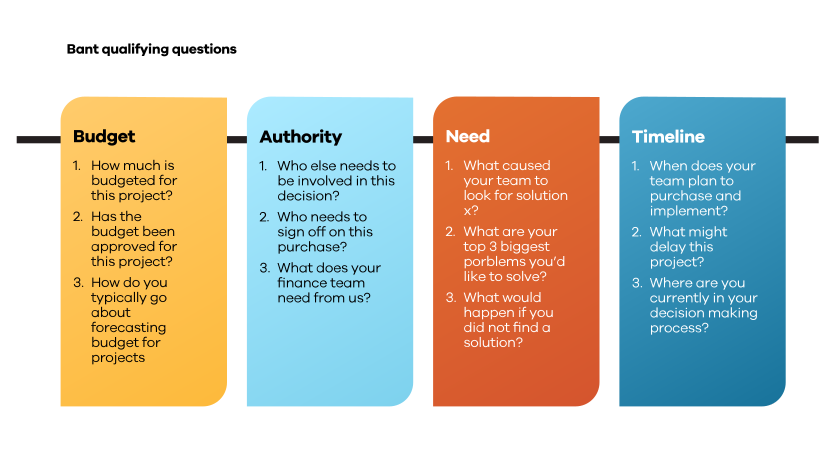
This page covers how each BANT component works, a step-by-step way to apply it in a qualifying call, where the framework runs into trouble on enterprise deals, and how BANT has evolved to account for buying groups and digital engagement signals.
How BANT Works
Each letter checks a different condition before a rep commits time to a deal:
- Budget: Can this account afford the solution, and does the cost make sense against the return they’d get from it?
- Authority: Who actually signs off on the purchase, and who else influences that decision?
- Need: Is there a specific, named problem driving the search for a solution, or just general interest?
- Timeline: Is there a reason this account needs to decide now rather than next quarter?
A rep who checks all four before investing serious time avoids two common mistakes: chasing deals that feel active but were never going to close, and under-resourcing the accounts most likely to buy. BANT’s job is to filter fast, sorting out whether a deal deserves real time before committing to a full deal management process.
This kind of filter only works with consistent application. Applying BANT loosely on one deal and rigorously on the next leaves a pipeline that looks qualified on paper but isn’t. That’s why we built Altify’s sales process around a single, sequenced set of qualification steps every rep follows, instead of leaving BANT to memory and personal habit.
Accelerate Sales with a Repeatable Sales Process
Match your sales process to customers’ buying cycles, get clearer pipeline visibility, and give your team what it needs to win.
Breaking Down the Four BANT Components
Here’s what each component actually checks for, and what a rep listens for when qualifying a live deal.
Budget: Confirming Financial Fit
This is the first filter, and it’s not about landing on an exact number this early. It’s about whether this account can afford what you’re selling at all, whether there’s funding allocated or a credible path to it for a problem in this general category. A prospect who loves the demo but has no budget cycle for twelve months isn’t qualified yet, regardless of how the conversation felt.
Authority: Mapping the Buying Group
Even a deal that clears budget can stall for months if it lands with the wrong person. Enterprise purchases are rarely approved by one individual: a budget owner, a technical evaluator, and an executive sponsor typically all weigh in before a contract moves.
Qualifying “authority” means mapping the buying group early, not stopping once you’ve found one enthusiastic champion. Once you move past the first qualifying call, that ongoing work becomes Relationship Mapping. MaxAI auto-populates the buying group inside Salesforce, so a rep isn’t rebuilding the org chart from memory every time a new stakeholder shows up.
Need: Connecting to a Real Pain Point
A prospect can sit through an hour-long demo, ask sharp questions, and still not be qualified. Interest isn’t the same as need, and a prospect can be genuinely engaged in a conversation without having a problem worth solving right now. Take a mid-size logistics company evaluating a new operations platform: the deal isn’t qualified until the VP of Operations can point to a specific operational cost of the status quo, rather than general curiosity about the category. A named, costed problem qualifies a lead. Polite interest doesn’t.
Timeline: Reading Urgency Signals
Budget and the right buying group still won’t close a deal with no urgency behind it. Timeline separates an account that’s ready to act from one that’s window-shopping. A renewal date, a compliance deadline, or a leadership mandate all create the kind of pressure that moves a deal from the top of the funnel to the bottom. Without one, a deal can sit “in progress” indefinitely.
How to Apply BANT: A Step-by-Step Qualifying Process
Knowing what BANT checks for is different from asking about it well. Here’s how each step plays out in an actual qualifying conversation.
Step 1: Confirm the Budget
Ask about budget directly, early, and without apologizing for it. Open with something like “What budget range are you working with?” or “How does your team typically allocate resources for a solution like this?”
Tip: Frame the question around their planning process, not a number. That keeps it from feeling like an interrogation.
Step 2: Identify Who Holds Authority
Org charts rarely match how the decision actually gets made. Put it to them directly: “Who holds the authority to make this decision?” and “Who else is involved in evaluating it?”
Tip: Treat your primary contact as a source of intelligence on internal politics, and ask how similar decisions have been made before.
Step 3: Surface the Need
Prospects tend to give a surface-level answer on the first ask. Push past it with “What current issues are hindering your operations?” and “What would need to be true for this to be worth solving now?”
Tip: Listen for a specific, describable cost. A vague “we’d like to improve things” isn’t a need yet.
Step 4: Clarify the Timeline
Deadlines change how a prospect weighs your solution against everything else competing for attention, so get specific: “When are you aiming to have a solution in place?” and “Are there deadlines or milestones tied to that date?”
Tip: If there’s no real deadline, say so internally. A deal without a timeline needs nurturing, not a forecast date.
Asking these questions well is only half the job. How a rep uses the answers matters just as much, and that looks more like a trust-building conversation than an interrogation.
What great looks like in selling
How do some sales teams build unbreakable customer trust and consistently win, retain, and grow revenue?

Benefits of BANT for Sales Teams
Applying BANT consistently changes where a sales team spends its time and how it forecasts:
- Sharper focus: Reps spend their hours on accounts that match the Ideal Customer Profile, instead of splitting attention across every inbound lead.
- Better resource allocation: Deals that clear BANT get the proposal work, the executive time, and the technical resources. Deals that don’t get nurtured instead.
- Higher conversion rates: A lead that’s confirmed on budget, authority, need, and timeline converts at a materially higher rate than one qualified on interest alone.
- More relevant messaging: Knowing the specific pain point and decision process lets a rep shape the pitch to the deal instead of running a generic deck.
- A shorter sales cycle: Confirming the buying group and the timeline up front removes the mid-cycle surprises that stall deals for weeks.
- Cleaner sales-marketing alignment: Both teams work from the same definition of “qualified,” which cuts down on disputes over lead quality.
None of that makes the framework complete, though. It has real gaps once deals get complicated.
Where BANT Falls Short
BANT is a fast filter, not a complete view of the account. Five gaps show up most often on enterprise deals:
- It misses context outside the four questions. Industry pressure, competitive dynamics, and internal politics all affect whether a deal closes, and BANT doesn’t ask about any of them directly.
- Budget and authority shift mid-cycle. A reorg, a new CFO, or a frozen budget can invalidate a “qualified” deal weeks after the fact. Treating BANT as a one-time checkpoint instead of an ongoing check costs reps late-stage deals.
- It doesn’t capture what the prospect actually cares about. Confirming a budget range says nothing about the priorities and preferences that shape which vendor they pick.
- It assumes one buying group, when there are often several. Complex accounts split authority across procurement, IT, and the business unit, each with a different threshold for what “qualified” means. Account mapping surfaces that structure before it derails a deal late in the cycle.
- It disqualifies too early. A lead that fails one BANT criterion today (usually timeline or budget) can still be worth nurturing rather than dropping. BANT has no built-in answer for “not yet.”
That’s not a reason to throw BANT out. It’s a reason to build on top of it.
Strategies That Complement BANT
Most sales teams pair BANT with at least one of the following instead of relying on it alone:
- Lead scoring models: Assign numerical weight to attributes beyond BANT’s four, so reps can prioritize leads that don’t cleanly pass or fail.
- Buyer personas: Document each stakeholder’s motivations and preferences in the buying group, beyond title and role.
- Behavioral data: Track website visits, content downloads, and engagement patterns for signals that a static BANT check misses.
- Consultative selling: Lead with guided selling that surfaces the prospect’s broader goals, rather than working strictly through a BANT checklist.
- Lead nurturing: Keep leads that fail BANT today in a structured nurture track instead of dropping them, so they resurface once budget or timeline changes.
Most of these strategies fill gaps that existed even before digital buying changed the picture. The next shift comes from how buyers behave online.
BANT 2.0: How Lead Qualification Has Evolved
Digital buying behavior has added signals that the original four questions didn’t account for. BANT 2.0 keeps the core framework and layers in:
- Engagement level: Email opens, click-throughs, and content downloads that indicate how close a prospect is to acting, before a rep ever asks.
- Fluid market approach: A different qualifying approach for the top of the funnel (broad, one-to-many) versus the bottom of the funnel (individualized, one-to-one).
- Customization fit: Whether the solution can realistically flex to the account’s specific requirements, beyond generic category fit.
- Competitive awareness: How aware the prospect is of alternatives, and how that awareness is shaping their evaluation.
- Long-term relationship potential: Whitespace for future expansion, referral potential, and repeat business all factor into account planning, even when they don’t affect whether this specific deal closes.
Put all of this together, and a clearer picture emerges of what the framework is actually good for today.
Where BANT Fits Today
BANT still answers the question it was built for: is this lead worth pursuing right now? It was never built to answer who beyond the obvious approver actually has a say, what happens if the budget disappears next quarter, or how a deal fits into a longer account relationship. Pairing it with buying-group mapping, lead scoring, and the BANT 2.0 signals above closes most of that gap without discarding a framework that still does its core job well.