What is Target Account Selling (TAS)?
Target Account Selling is a B2B sales strategy that identifies high-value accounts with the greatest revenue potential and pursues them through deep account research, personalized engagement, and a cross-functional revenue team, instead of a single rep working alone. It’s built for complex, multi-stakeholder deals where no single seller can cover the whole buying group.
TAS Methodology
TAS methodology follows five stages, from defining the target account profile to measuring and refining the plan over time. Altify has been around since the beginning of target account selling. We shaped the category, with TAS methodology built into our software from the start.
1. Define the Target Account Profile
Not every account deserves the same investment of time. TAS starts by scoring accounts against the ideal customer profile: firmographic fit, revenue potential, and how closely the account’s buying process aligns with how the revenue team sells. Accounts that clear the bar move onto the target list. The rest stay in a lower-touch motion, so reps aren’t burning hours on deals that were never going to justify the effort.
That’s the difference between target account selling and a shotgun approach. The target list should be sized to what a seller can realistically research and engage, not just a label for “every account we’d like to close.”
2. Map the Buying Group
High-value accounts rarely have a single decision maker. TAS treats the account as a buying group: a network of champions, economic buyers, technical evaluators, and blockers who each weigh in differently on a purchase. Relationship Mapping gives sellers a structured way to identify who holds influence, who is a supporter, and who still needs to be won over, rather than relying on a single title on an org chart.
This stage also relies on stakeholder mapping to expose relationship gaps early, before they turn into late-stage surprises that stall a deal in committee.
3. Build the Account Plan
Once the buying group is mapped, the account plan connects what the customer is trying to achieve with what a TAS-driven seller can deliver. This includes the customer’s business objectives, the whitespace available inside the account, and the specific actions needed to move each opportunity forward.
A written account plan turns “we know this account well” into something concrete: a record the whole revenue team can execute against, not a set of details locked in one seller’s head.
4. Align the Revenue Team
TAS only works when sales, marketing, and customer success execute against the same account plan. Marketing shapes the content and outreach to buying-group members that a seller can’t reach directly. Customer success protects the relationship after the sale, which determines whether the account expands or churns.
Coordinating the revenue team around one plan makes personalized, account-specific engagement possible at scale. No single seller, working alone, can pull that off.
5. Measure and Refine
TAS is not a plan you write once. Win rate, deal velocity, and forecast accuracy indicate whether the account plan and buying-group map remain accurate or whether the account has shifted since the last review.
Strategic Account Planning treats these check-ins as a standing part of the process, not a one-time report filed after the deal closes. As stakeholders change, budgets shift, or new whitespace opens up, the account plan needs to keep pace.
The Problem with Lone Wolf Selling
A lone-wolf seller works an account alone: researches it, pitches it, and moves on to the next one. That gets a proposal in front of a customer, but it rarely builds the account understanding that a complex sale needs.
Complex B2B deals involve multiple stakeholders, longer cycles, and more scrutiny than any one seller can handle alone. A transactional, one-person sales motion doesn’t match how enterprise buying groups actually make purchasing decisions.
Why Buying Groups Require a Team
Mapping a buying group is only half the work. Selling to one takes a team of your own, not one person working alone.
Buyers Expect More
Buyers expect more from the buying experience than a transactional pitch. They want a seller who understands their business, their challenges, and their goals as well as they do.
That expectation rises with the size of the decision. A transactional seller can still close small, low-stakes deals, but on anything bigger, buyers expect to be guided by someone acting as an advisor, not just a rep taking an order.
What great looks like in selling
How do some sales teams build unbreakable customer trust and consistently win, retain, and grow revenue?

For buyers, working with a selling team invested in their business pays off over time. As veteran seller Scott Jackson points out in Not Just Another Vendor, buyers choose a solid relationship with sellers who understand and solve their challenges over a product fit alone.
“When you come up in a sales culture that doesn’t think strategically, nor does account planning, everything is opportunistically focused,” Scott says. “A lot of the salespeople I encounter basically just show up in front of potential customers and say, ‘Here’s my list of tools; what can I sell you today?’ instead of coming in with the intent to understand more deeply how they can help someone achieve their goals.”
Scott continues: “It’s a challenge for people to begin reframing their approach to understanding who’s who within an account and what value we want to create for them. It really is a paradigm shift.” But Scott believes it’s a shift worth making.
Time with Buyers is Slipping, and Every Interaction Counts
Target account selling isn’t new, but the way B2B buying happens has shifted enough to make it more relevant, not less. Buyers now spend less face-to-face time with sellers and do more research on their own, through digital channels marketing can shape and sellers can use.
That shift raises the stakes on every interaction a seller does get. A lone wolf seller, working without that support, struggles to keep up and often loses out to a seller backed by more resources.
TAS Runs on the Entire Revenue Team
A targeted approach to key accounts (a defined list of accounts likely to close) matters. But growing revenue inside those accounts is a team effort, since no single seller can cover every part of the buying process alone:
- Bringing in executive sponsors when needed
- Collaborating with customer success and marketing teams on plans that address customer needs
- Making sure you have the content needed to differentiate from the competition when tackling especially challenging accounts with large buying groups
Without the revenue team behind an account, target account selling breaks down. These are the fundamental components of the revenue team:
- Sales
- Customer success
- Marketing
- Executive leadership
Is Target Account Selling for Everyone?
TAS has proven benefits for sales organizations, but it takes full commitment and the right revenue team in the right selling environment to reap its full benefits. Target account selling works best in B2B environments where revenue teams act as advisors, not order-takers.
It also works best under specific conditions. A well-defined ideal customer profile makes TAS more effective than it would be for a company that appeals broadly to anyone. And because Target Account Selling requires a significant investment, the return only makes sense for companies that use TAS fully, not for businesses that mostly work smaller deals.
That’s not to say TAS only works for key accounts. Many revenue teams apply the same strategies used on key strategic accounts to a broader territory or portfolio of smaller accounts, as long as the finances justify it: big deals help pay for the investment it takes to win new accounts and grow revenue in existing ones.
Why Target Account Selling is Vital in Complex Sales
TAS takes real investment to run well. That investment pays off through a lift in revenue, stronger customer relationships, and higher customer lifetime value, especially in businesses with long, complex sales cycles.
Enhanced Sales Efficiency and Productivity
Concentrating effort on high-value accounts makes TAS efficient. Sellers spend less time chasing accounts that were never going to close and more time on the ones that will, and the account-specific messaging a mapped buying group makes possible shortens the sales cycle further.
Increased Revenue and Profitability
TAS trades volume for depth. Revenue teams concentrate on the accounts most likely to expand rather than spreading effort evenly across a full pipeline, which tends to produce bigger deals, stronger retention, and more upselling opportunities inside accounts a seller already understands well.
Deeper Customer Relationships and Satisfaction
A prepared seller, backed by the full revenue team instead of working alone, handles customer interactions with more relevant context and fewer generic pitches. That consistency, over time, turns an account into a long-term relationship rather than a single sale.
Veteran sellers who have run TAS at scale share more of what works in our book, Not Just Another Vendor.
See how Altify has built TAS methodology into its software at altify.com.
Frequently Asked Questions
What does it mean by target account?
A target account is a company that fits the ideal customer profile and shows the greatest potential to generate revenue, based on fit, budget, and growth potential. In Target Account Selling, sales teams research these accounts in depth before engaging, rather than pursuing every lead that comes through the door.
What does account-based selling mean?
Account-based selling (ABS) is the broader practice of prioritizing named, high-value accounts. Target Account Selling (TAS) is a structured approach for complex deals that combines deep account research, personalized engagement, and coordinated action across sales, marketing, customer success, and executive leadership to cover the full buying group.
What are the key steps in Target Account Selling?
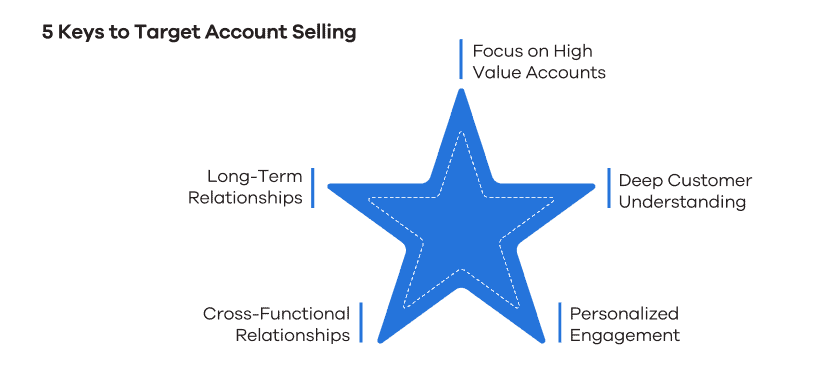
Target Account Selling runs on five keys: focusing on high-value accounts with significant revenue potential, building a deep understanding of each customer’s business challenges and goals, personalizing engagement to address specific account pain points, coordinating cross-functional relationships across the revenue team, and sustaining long-term partnerships with key decision-makers.