What is Buying Intent?
Buying intent is the likelihood that a potential customer will act on a purchasing decision, and the motivation, need, and urgency behind that action. A prospect downloading a whitepaper carries different weight than one requesting pricing. The download can wait for a follow-up email tomorrow; a pricing request should get a phone call today, before a Revenue Team loses the account to a competitor that responded faster.
Purchase intent isn’t evenly distributed across categories. Smartphones and laptops sit at the high end, with purchase intention around 34% and 25% respectively, which is one reason consumer electronics brands invest so heavily in comparison content. Enterprise software buying works differently: fewer buyers, higher stakes, and a decision that rarely rests with one person. In a complex B2B sale, that intent spreads across a buying group of stakeholders who each weigh the decision differently.
From here: what buying intent looks like at each stage, the signals that separate one stage from the next, and what a Revenue Team does once it has that information.
Understanding Buying Intent
Ask a sales rep to define buying intent and most will describe a feeling: this account is “warm,” this one’s “just kicking tires.” The reality is more structured. Buying intent moves along a spectrum with three distinct levels, and knowing which one a buyer is in changes what you should say to them next.
Informational Intent
A buyer at this stage may not know yet that they’re buying anything. They’ve noticed a problem, maybe a process that’s too slow or a number that keeps missing target, and they’ve started looking for language to describe it.
This is the research phase: identifying pain points, browsing available approaches, and forming a rough sense of what a solution needs to do. Nothing here is vendor-specific yet. The buyer is building a mental model, not a shortlist.
Navigational Intent
Somewhere between “I have a problem” and “here’s my shortlist,” the buyer’s questions change shape. Instead of “what could fix this,” they start asking “which of these fixes this best.”
They’re now comparing named options against a working list of requirements, weighing features and fit against what they learned in the research phase. The decision at this point is less about whether they’ll buy and more about whether your solution belongs on the shortlist at all.
Transactional Intent
By the time a buyer reaches this stage, the analysis is largely done. They’ve compared options, built a case internally, and are now working out how to close, not whether to.
For a product purchase, that usually means choosing among a short list of vendors. For a software purchase, it often means one more decision layer: build versus buy. Someone evaluating an ERP replacement, for instance, may still weigh a custom build against an off-the-shelf platform even after they’ve settled on the category. And in enterprise deals, this stage rarely rests with a single signer. Multithreading, keeping multiple stakeholders across the buying group engaged in parallel, often decides whether a transactional-intent deal closes or stalls waiting on one more approval.
Different Aspects of Buying Intent
Knowing the stage is only useful if it changes what you do next. Each level calls for a different kind of content and a different kind of attention.
1. Educational Content for Informational Intent
Buyers here aren’t ready for a pitch, and treating them like they are usually costs you the relationship. Content that helps them think earns attention instead: blog posts, whitepapers, and guides that name the pain point clearly and explore it without steering toward a product. The payoff takes longer to show up: trust that compounds if you’re still in the picture by the time they reach the next stage.
2. Showcasing Differentiators for Navigational Intent
Once a buyer has a shortlist, the question changes from “what’s out there” to “why you.” This is where case studies, side-by-side comparisons, and customer proof carry weight, because the buyer has already decided the category matters and now needs a reason to pick one name over another. Being the source they trusted during the research phase gives you a real head start here, since credibility built early tends to carry forward.
3. A Simpler Conversion Process for Transactional Intent
At this point the buyer has decided; what’s left is whether your process gets in the way. Site UX, clear feature and pricing information, and a straightforward path to purchase can matter as much as the product itself. It’s a real lever: some teams report conversion lifts of up to 200% just from cleaning up this last stretch.
That’s the play at a glance. Signal by signal, and what a Revenue Team actually watches for, comes next.
Factors Affecting Buying Intent
Stage tells you where a buyer is; the factors below explain why. Most of them shift a buyer’s intent up or down in specific, spottable moments, not as a general mood.
Business Objectives & Pain Points
An account’s buying intent usually traces back to a specific business objective that’s slipping, not a vague interest in “improving things.” A mid-size retailer whose customer satisfaction scores are dropping because of inventory mismanagement is trying to fix a specific number its leadership is already asking about, not shopping for software in the abstract.
A Revenue Team should watch for that exact moment: a prospect describing a metric problem in specific terms is a stronger signal than one browsing a features page. Lead with the pain point (in this example, inventory visibility and demand forecasting) before naming your own solution, and connect it to their stated objective rather than a generic pitch. A stated business objective like this frequently surfaces Whitespace inside an existing account too, since it points directly at where the account still has room to grow.
User Experience & Interface
Nobody buys software because the login screen looks nice, but a clunky one is enough to lose them. A clean interface doesn’t create buying intent on its own, but a confusing one will quietly kill it. Buyers read usability as a proxy for how much support they’ll need after the sale, so an intuitive layout and clear navigation build confidence before a single sales conversation happens.
Picture a startup evaluating project management platforms for a distributed team: drag-and-drop task boards and a working dashboard, versus a competitor’s dense settings screen, and the choice often gets made before pricing enters the conversation.
Scalability & Integration
This factor rarely gets asked about directly. Few enterprise buyers will say “this needs to scale” outright, but nearly all of them are testing for it. The underlying test is whether the solution grows with the business or turns into a replacement project within eighteen months. A platform that fits cleanly alongside existing systems, without adding a new data silo, answers that question before it’s asked.
Security & Compliance
Every other factor on this list can be a strong positive signal. This one is different: it’s rarely a reason to buy, but it’s often a reason to walk away. Data security concerns matter everywhere, but in regulated industries they can override every other signal entirely. A healthcare provider shopping for cloud-based document storage will filter out vendors that can’t demonstrate HIPAA compliance before evaluating anything else about the product.
This factor tends to matter earliest, decided in the informational and navigational stages rather than negotiated at the end. Vendors who lead with specifics, end-to-end encryption, access controls, and named compliance standards, clear this bar faster than ones who address it only when asked.
Altify’s Salesforce-native architecture means this conversation starts from an existing trust boundary rather than a new one.
Support & Training
The signature isn’t the finish line. What happens in the following ninety days shapes whether the relationship holds, which is why buyers increasingly factor in the support and training that comes with a purchase as much as the purchase itself.
Buyers increasingly factor in the support and training that comes with a purchase as much as the purchase itself, because a solution nobody uses correctly delivers no return regardless of feature set. Watch for this in the transactional stage: a prospect asking detailed onboarding questions late in the cycle is usually already planning for life after the purchase, a strong signal of real commitment.
Value Proposition & ROI
Strip away everything else on this list, and it comes down to one question: is it worth what it costs? A clear value proposition and a credible ROI case make that case; overplaying it reads as pressure, and underplaying it leaves the buyer unsure what they’re actually getting.
The right balance shifts by stage. Early on, value proposition should stay light and informational; by the navigational and transactional stages, buyers expect and want a direct ROI conversation.
Personalization & Customization
Generic pitches read as generic to buyers who’ve done their homework. A configurable solution, custom pricing, or recommendations based on actual usage signals something specific: that the vendor is paying attention to this account rather than running a script.
A marketing automation platform that lets a buyer build campaigns around their own customer behavior data, instead of a fixed template, is the kind of specificity that moves a deal forward. It’s the same instinct behind Customer-centric selling, where the account’s priorities set the agenda instead of a standard pitch.
Proof of Concept & Trial Periods
Claims are cheap. Letting a buyer test something directly is not, which is exactly why it works so well. A proof of concept or trial period turns “we say this works” into “you saw this work,” a claim the buyer verified instead of one they took on faith. A project management platform offering a free 14-day trial removes buyer risk and collects real usage data on what that account actually needs, sharpening the pitch for the next stage.
The same logic applies to Altify itself: a Request a Demo conversation does more to move a skeptical buyer than another data sheet would.
Thought Leadership & Industry Recognition
First impressions here happen long before a rep ever gets on a call. Credibility earned before the sales conversation starts changes how everything after it lands.
A vendor recognized at industry events or cited in authoritative content walks into the conversation already known, a meaningfully different starting point than walking in as another rep making a pitch. That recognition carries the most weight in the informational stage, and it does double duty: the same content that builds trust with buyers often earns search visibility as well.
That recognition compounds when it’s tied to a named methodology, which is part of why Altify leads with Strategic Account Planning rather than a generic product pitch.
Road Mapping & Product Development
This is the one factor buyers rarely name out loud but always weigh: they’re not just evaluating the software in front of them, but the next three years of it.
A visible roadmap signals the vendor keeps investing in the product, and a track record of shipping features that came from customer feedback signals something more specific: that this vendor listens. Both move buying intent even when the current feature set already meets the stated requirements.
Reading these ten factors in a live conversation is one thing. Catching them at scale, across an entire pipeline, is where data has to take over.
Using Data to Identify Buyer’s Intent
Everything above is easier to see in hindsight than in the moment, which is why data matters as much as instinct. Behavior, engagement, and conversion patterns, tracked consistently and surfaced automatically by MaxAI, show where a buyer actually sits on the spectrum rather than where they claim to sit.
Website analytics platforms, heatmaps, and feedback surveys all feed this picture. The point is acting on it. See which content is doing the work at each stage, and cut or rework the pieces that aren’t.
Building Customer-Centric Content for Each Buying Intent Stage
The playbook above covers the “what.” This section covers the “how,” once it’s built into a content plan and, for Altify customers, into the Sales Process a Revenue Team already follows inside Salesforce.
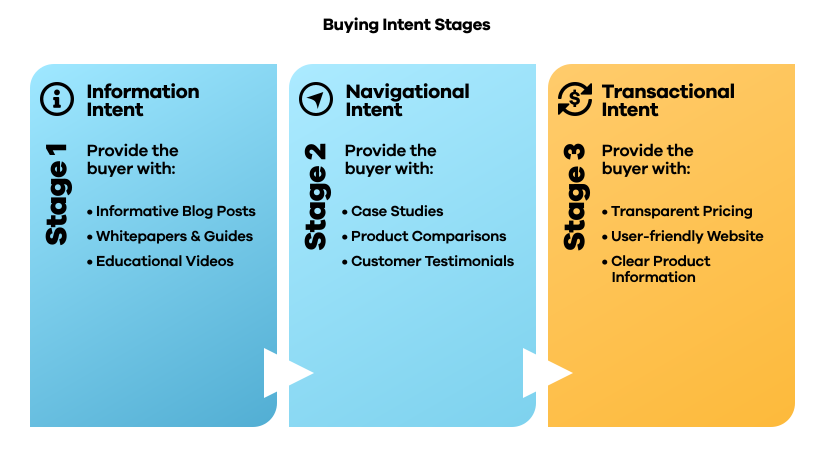
1. Informational Intent: Addressing Pain Points & Providing Valuable Insights
Nobody at this stage has decided to buy anything yet, which is exactly why a hard pitch backfires. The job here is narrower. Name the pain point clearly enough that the buyer recognizes it, and offer something useful before asking for anything back.
Content strategies:
- Informative blog posts that dig into a specific pain point your audience actually has, with a complete answer instead of a teaser.
- Whitepapers and guides that walk through industry trends and practices in enough depth to demonstrate real expertise.
- Educational videos that make a complex idea concrete, especially where a written explanation would take three times as long.
Example: A growing e-commerce business is losing money to fulfillment delays caused by inventory mismanagement. At the informational stage, they start researching the problem generally, not shopping for a vendor. A blog post titled “Mastering Inventory Management: A Guide for E-Commerce Businesses” meets them there: it covers best practices and context without pushing a product. That restraint earns the second visit more reliably than a pitch would.
2. Navigational Intent: Showcasing Differentiators & Building Trust
A buyer with a shortlist has already stopped asking whether they have a problem. The only thing left to decide is which name on that list beats the other three tabs still open in their browser. This is a competitive moment, and content needs to act like it.
Content Strategies:
- Case studies that show a real account with a similar problem and what changed after they solved it.
- Product comparisons that lay out your position against competitors honestly, including where you’re not the best fit.
- Customer testimonials that let someone else’s voice describe the outcome, in terms a prospect trusts more than a vendor’s own pitch.
Example: Continuing the inventory-management example, that same e-commerce buyer is now comparing three or four platforms. A case study placed where they’re already searching, paired with an honest comparison page, does more to build trust here than another feature list would.
3. Transactional Intent: A Simpler Conversion Process & Instilling Confidence
The research is done and the decision is close to made; what happens next either confirms it or introduces doubt at the worst possible moment. This stage rewards clarity and punishes friction.
Content Strategies:
- Clear, concise product information, features, pricing, and plans laid out without requiring a sales call to decode them.
- A straightforward website experience, an easy checkout path with as little friction as possible before it costs you the deal.
- Transparent pricing and terms, billing cycles and contract terms stated up front, with no surprises waiting at the signature.
- Trust-building elements, security badges, compliance certificates, and reviews that answer the doubts a buyer won’t say out loud.
None of this content plan stays accurate on its own. It only holds up if the data behind it keeps getting checked.
Using Buying Data Insights for Continuous Improvement
None of this is a one-time setup. Buying intent data keeps producing signal long after the first campaign launches, and the teams that keep watching it outperform the ones that built a plan once and left it alone.
That data feeds back into Altify Insights, where a Revenue Team is already tracking account activity. It improves the customer experience and keeps product development in step with what customers are actually asking for, and a sharper content strategy tends to follow from both. Analytics platforms, heatmaps, and feedback surveys remain the primary sources. The variable over time is how deliberately a team acts on what they show.
All of this only matters if it changes what a Revenue Team actually does next.
Turning Buying Intent Into Revenue
Buying intent moves. A signal calculated once and filed away is already stale by the next interaction, at the individual level and across the buying group, which is why reading it has to be a habit rather than a one-time score.
The three stages themselves won’t change as buying behavior evolves, but the signals inside them will keep getting subtler and spread across more stakeholders. A Revenue Team that keeps tracking informational, navigational, and transactional signals at both the individual and buying-group level has a clearer read on which accounts are actually ready to move, and which ones just look busy.
See how Altify helps Revenue Teams read buying signals earlier.