Meetings, Better Sales Meetings
4 minutes read
This is an edited extract from my latest research publication: Thriving in the Whirlwind: Four Insights to Grow Revenue Now
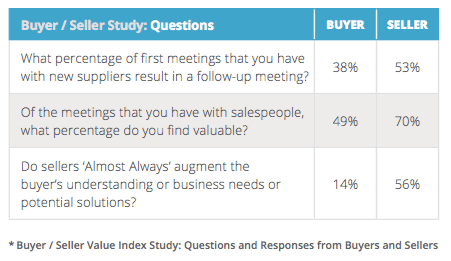
The first significant point of customer engagement for most sellers is usually a sales meeting – but sadly for many sellers, the first meeting is also the last. Altify’s Buyer / Seller Value Index study showed that buyers only held follow-up meetings with new suppliers in 38 percent of cases.
Given that the 2017 Business Performance Benchmark Study put the average cost (direct costs only) of meetings that don’t progress to a second meeting at over $50,000 ($38,635 for sellers and $11,816 for customers), it’s clearly of some importance to all parties to avoid ‘dead-ends.’ This paucity of follow-up meetings contradicts sellers’ belief that they perform well – 70 percent of sellers believe their sales meetings are ‘valuable’ to the customer. Buyers disagree – less than half (49 percent) share the same view – and so they vote with their feet. This poor performance – and the divergence of perceptions between buyers and sellers – ought to be a cause for concern among sellers everywhere.
So what can you do to make your meetings better?
It goes without saying that the key to making a sales meeting valuable to a customer is the level of engagement with the customer – the more engagement, the greater the buyer’s perception of value added.
But again, the Buyer / Seller Value Index research paints a bleak picture. Only 14 percent of buyers agree that sellers ‘almost always’ augment their understanding of business needs or potential solutions. Only 1 in 7 – no wonder buyers don’t want follow-up meetings!
So where’s the problem – or the opportunity, if you’re of a positive frame of mind?
When a prospective customer allocates time for a meeting they expect to learn something or get value. They assume that the seller will have a reasonable understanding of their industry, their business and the challenges they face. Given that the seller has products or services that are designed to solve these business problems, and the seller and others in the seller’s company should have experience with other similar customers, it is reasonable to expect that they should be able to add value.
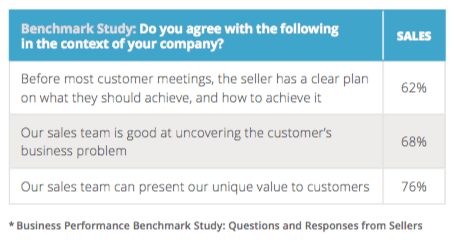
Yet in the Benchmark Study buyers said more than one third (38 percent) of sellers had no clear plan for what they wanted to achieve from the meetings, nor how to achieve it. in addition, buyers believed a similar percentage of sellers (32 percent) were not good at uncovering customers’ business problems.
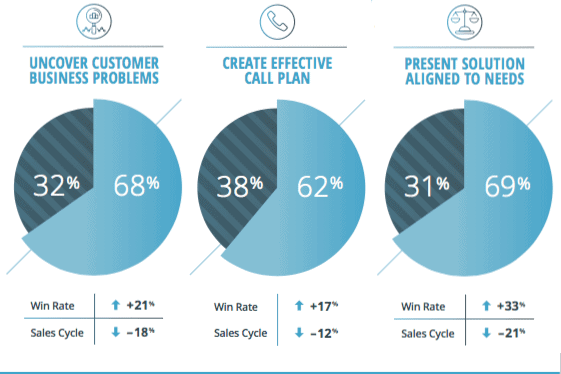
It’s hardly surprising that without a sales call plan so many buyer / seller interactions stumble or stagger. This is an easy fix – with a worthwhile pay-off. According to the Benchmark Study the quantified impact of a considered plan for every call is an increase in Win Rate of 17 percent and a reduction in Sales Cycle of 12 percent, resulting in an increase in overall sales productivity of 33 percent (the multiplier effect of the two).
But solving the second issue by presenting your solution in a manner that aligns with the customer’s needs is the single biggest performance lever available to sellers. According to the Benchmark Study, doing so drives a Win Rate increase of 33 percent and a Sales Cycle that is 21 percent shorter. The combined effect is a 68 percent increase in the amount of revenue that you can achieve in any period of time. For example, instead of winning one deal out of four, you now win one deal in every three, and deals now take four months to close instead of five.

Can you afford not to look again at how you prepare to bring value to your customer in each and every meeting?
Effective customer engagement can drive up to 68 percent increase in revenue; but only if you work at it is Insight #1 from Thriving in the Whirlwind: Four Insights to Grow Revenue Now which analyzes the 80,000 data elements of the Altify Buyer / Seller Value Index Study (2016) in combination with the 60,000 data elements of the Business Performance Benchmark Study (2017) to derive fresh insights into revenue growth opportunities in a fast-changing world.
Download THRIVING IN THE WHIRLWIND here
By: Altify · January 15, 2018
Categories: