Solution Comparison
Altify vs DemandFarm
Account Planning Tools Compared
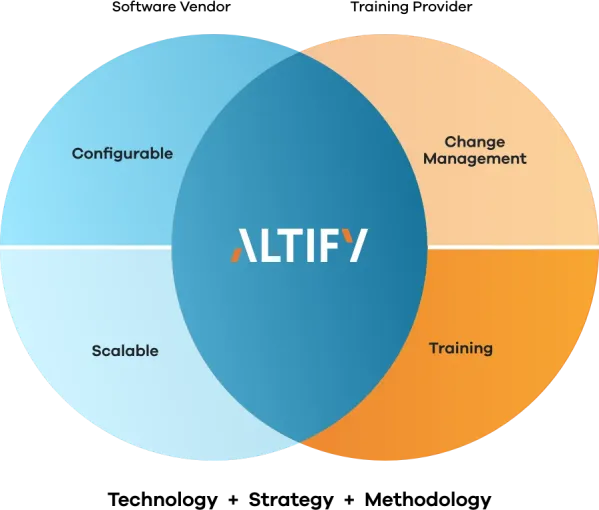
Altify vs DemandFarm compares two Salesforce-native account planning software platforms. Altify and DemandFarm support existing sales methodologies. Altify also supplies Target Account Selling and Revenue Enablement Services. Both offer account planning and relationship mapping inside Salesforce, and their differences lie in platform scope, AI design, and the services each vendor offers after rollout.
Feature comparison
| Capability | Altify | DemandFarm |
|---|---|---|
| Salesforce-native scope | Built inside Salesforce as one connected layer across account planning, sales process, and forecasting | Account Planner, Org Chart, Opportunity Planner, White Space Planner, and Relationship Maps modules, plus the Kampanion copilot, which also connects to HubSpot and Microsoft Dynamics |
| Sales methodology | Altify’s own Target Account Selling (TAS), embedded in Altify Sales Process; also supports MEDDIC, MEDDPICC, Sandler, or a team’s existing approach | Configurable Opportunity Planner scorecards for SPIN, MEDDIC, MEDDPICC, or a custom framework |
| Relationship Mapping | Buying group and stakeholder mapping built into MaxAI and Altify Accounts | Relationship Maps module |
| Whitespace and account growth | Whitespace analysis inside Altify Accounts | White Space Planner module |
| AI capabilities | MaxAI: real-time coaching, auto-populated key players, and competitive research inside Claude, Copilot, ChatGPT, and Agentforce | Kampanion, an account-management copilot that draws on Salesforce, HubSpot, and Microsoft Dynamics data plus email, meeting, and call sources |
| Services | Revenue Enablement Services: workshops, coaching, change management, and KPI measurement | Professional services and customizations, listed on DemandFarm’s pricing page |
| Pricing model | Quote-based, scoped to seats, methodology configuration, and services | Quote-based, gated behind three company-size tiers (under 500, 500 to 5,000, over 5,000 employees) |
Where each platform’s sales methodology comes from
Of the rows in that table, sales methodology shapes the rest of the fit most. DemandFarm’s Opportunity Planner configures scorecards to the framework a team already runs, whether that is MEDDIC, MEDDPICC, SPIN, or a custom model. Altify supports existing frameworks too, including MEDDIC, MEDDPICC, and Sandler.
Altify also supplies a methodology of its own. Target Account Selling runs through the Altify Sales Process, embedded across account planning, opportunity management, and forecasting. Revenue Enablement Services reinforce it with workshops, deal coaching, change management, and KPI measurement. That service layer matters most for a Revenue Team where adoption is a harder problem than structure.


Relationship Mapping and AI guidance compared
Methodology is one difference. How each platform surfaces relationships and risk day to day is another. DemandFarm’s Relationship Maps module covers stakeholder mapping, and its White Space Planner module surfaces cross-sell and upsell opportunity.
Kampanion is DemandFarm’s account-management copilot. It draws on CRM data from Salesforce, HubSpot, or Microsoft Dynamics, plus sources such as Outlook, Gmail, Teams, Slack, and Gong, to answer questions about relationships, whitespace, and risk.
MaxAI runs relationship and whitespace guidance from inside Altify Accounts. It surfaces next-best actions, missing stakeholders, and structural deal risk inside the AI assistants a rep already uses (Claude, Copilot, ChatGPT, and Agentforce). Each recommendation is grounded in live Salesforce data, with no separate AI interface required.
Salesforce-only versus multi-CRM scope
Kampanion’s range of CRM sources points to a wider difference in scope: which CRMs each platform runs inside. DemandFarm’s modules are used with Salesforce, and its Kampanion copilot also connects to HubSpot and Microsoft Dynamics. A team running account planning across more than one CRM has a real reason to weigh that reach.
Altify’s execution layer runs inside Salesforce, on the same records sellers already use. Teams standardizing on Salesforce get one platform to manage. Teams operating multiple CRMs need to weigh that scope directly.

Pricing: what’s actually published
DemandFarm pricing and Altify pricing are both quote-based, and neither company publishes a public rate card. Native scope and methodology both feed into what a quote ends up covering, and both vendors follow the sales-led model typical of enterprise Salesforce platforms.
DemandFarm’s pricing page is structured around three company-size tiers (under 500 employees, 500 to 5,000, and over 5,000), each gated behind a “reach out for pricing” request. Features expand at each tier. DemandFarm’s pricing page, checked in November 2026, still lists four Enterprise features (account-health insights, auto-generated action plans, a “1-click account plan summary,” and a “KAM AI assistant”) with a “Coming soon in 2025” footnote.
Altify’s quote reflects seat count, methodology configuration, and how much Revenue Enablement Services scope is included. For either platform, the most reliable number is a direct quote.
Which platform fits your team
In a DemandFarm vs Altify decision, two team profiles come up most. Native scope, methodology, and pricing structure each point toward one of them.
Altify fits Revenue Teams that:
- Want the platform to supply a proven methodology, Target Account Selling, backed by coaching and change management
- Need account planning, opportunity management, and forecasting standardized inside Salesforce
- See methodology adoption across a large Revenue Team as the challenge to solve first
DemandFarm fits teams that:
- Run a defined qualification framework, such as MEDDIC or MEDDPICC, and want configurable scorecards for it
- Want a copilot that connects to HubSpot or Microsoft Dynamics as well as Salesforce
- Need relationship mapping and whitespace visibility most, with methodology handled internally
What should you ask before choosing between Altify and DemandFarm?
The platform differences above give each vendor a different story to demonstrate. This evaluation script works for both demos, and the third column shows what a strong answer looks like.
| Question for the demo | What to request | What a strong answer looks like |
|---|---|---|
| Where does account-planning data live? | A live walkthrough of one account plan, Relationship Map, and opportunity on the CRM records the team uses | The plan, map, and opportunity all update the same shared records, with no second copy to reconcile |
| How does the platform apply a sales methodology? | The methodology criteria inside an account plan and an opportunity stage | The criteria sit on the record itself, and a manager can coach against them in the same view |
| How are relationships and whitespace surfaced? | One account mapped end to end, from stakeholders to whitespace | Stakeholder roles, relationship gaps, and whitespace appear on that account without an export |
| What does the AI read, and what does it return? | The list of records and activity sources behind each recommendation | Every input source is named and governed by permissions an admin can see |
| What is included in the quote? | An itemized quote for the proposed rollout | Seats, implementation, methodology configuration, AI usage, and services each appear as separate lines |
Compare the answers against the team’s CRM environment, methodology, and adoption needs before choosing a platform.
Frequently asked questions
Whichever profile fits, these seven questions come up most when narrowing the decision between the two platforms.
DemandFarm’s modules, including Account Planner, Org Chart, and Opportunity Planner, are used with Salesforce, and its Kampanion copilot also connects to HubSpot and Microsoft Dynamics. Altify runs inside Salesforce as one connected platform.
DemandFarm works with CRMs beyond Salesforce through its Kampanion copilot, which lists integrations with HubSpot and Microsoft Dynamics. Altify runs only inside Salesforce.
DemandFarm configures scorecards in its Opportunity Planner to the methodology a team already uses, including SPIN, MEDDIC, MEDDPICC, or a custom framework. DemandFarm’s pricing page also lists professional services and customizations. Altify supplies its own methodology through Altify Sales Process and offers Revenue Enablement Services to support adoption.
Altify can run MEDDPICC, MEDDIC, Sandler, or a team’s own methodology. Altify Sales Process comes with Target Account Selling, and implementation can configure it to the framework a team prefers.
Kampanion AI is DemandFarm’s AI copilot for key account managers. It answers questions about relationships, whitespace, and risk from CRM data in Salesforce, HubSpot, or Microsoft Dynamics, plus email, calendar, meeting, and call sources.
Altify stores its core account planning records inside Salesforce. MaxAI’s optional connections to Claude, Microsoft Copilot, and ChatGPT run through Altify’s MCP server.
Altify and DemandFarm use quote-based pricing, and neither publishes a public rate card. DemandFarm’s pricing page structures tiers by company size, all gated behind a sales conversation. Altify’s quote reflects seat count, methodology configuration, and enablement services scope.
Testimonials
What customers say
Feature and pricing differences are only part of the decision. Customer experience factors in as well.
Great account planning tool, achieving team collaboration
Altify provides easy access to account plans with a user friendly interface embedded in Salesforce. Ability to identify a strategy for relationship building within an account. Working with the implementation team and dedicated Success Manager has increased utilization throughout the users and provided proper support for the Sales Operation.
Gregg W.
Sr. Director, Global Sales Operations, Sales Onboarding & Education
Streamlining account planning across our Enterprise Sales Segments
The Altify Account Manager software is easy to use and configurable throughout the entire application, meeting our Enterprise sales team’s needs. It is a simple and organized experience to conduct account planning. Altify Account Manager integrates with Salesforce objects such as contacts, opportunities, and tasks, reducing duplication and entry, and it is a bi-directional sync with Salesforce.
Katy M.
Enterprise Sales Leader
Tool for Building Trust with B2B Clients
Altify has given our go-to-market team an easy-to-use, collaborative platform, native to Salesforce CRM (where they live), that allows them to manage every aspect of the trust equation. What are the key insights we learn about clients, and who are the people we need to build trust with? Where are the pockets of opportunities we can push on and develop over time? And more importantly, give the account/territory leader a collaborative platform to bring all the internal selling constituents into alignment, remove obstacles, and measure success.
Billy M.
Enterprise Sales Leader
Improved deal discipline with effective opportunity management
The methodology, structure, and process are easy to follow and have effectively increased win rates. It also serves as a way to identify earlier when to move on and not sink more time than required on deals that cannot be won or the payoff is not aligned with the amount of time and resources required to win.
Steve G.
Vice President Advanced Solutions Sales
Why Enterprise Revenue Teams Choose Altify
Those experiences point to three things that come up consistently in why teams choose Altify:
Account planning, sales process guidance, and AI-guided deal reviews run inside a single native Salesforce layer, all updating the same underlying records.
Revenue Enablement Services carries a team from initial training through ongoing coaching, leadership alignment, and measured adoption, the part that determines whether a methodology actually changes seller behavior.
Altify embeds Target Account Selling through Altify Sales Process and pairs it with enablement services that support adoption.
Chosen by Teams That Execute and Deliver Results


Compare other account-planning platforms
The same demo questions apply to the other account-planning platforms Revenue Teams often shortlist alongside DemandFarm.
Teams evaluating account planning software may also compare Altify and Backstory (formerly People.ai), Altify and Revegy, and Altify and Arpedio.
Ready to close the execution gap?
Teams can compare each platform’s methodology, Salesforce setup, and enablement program against their needs. Altify combines Salesforce-native account planning with Target Account Selling through Altify Sales Process and Revenue Enablement Services.